Why Am I Losing at Chess? The 6 Real Reasons
By Chessiro
Last updated July 2, 2026
Losing streaks feel random. They almost never are. Nearly every lost game below master level traces to one of six causes — and all six are fixable.
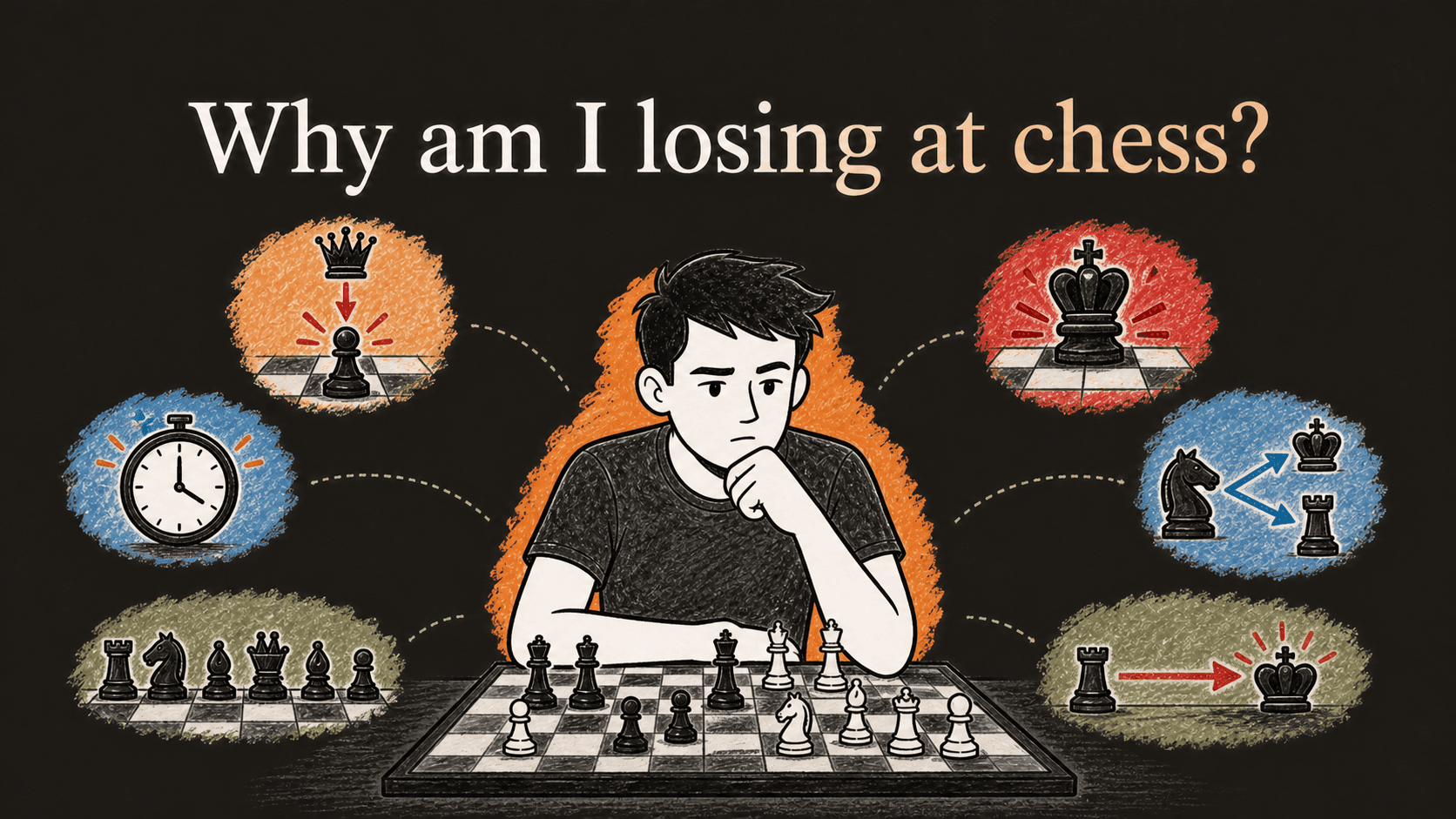
Every player types this question into a search bar eventually, usually after the third loss in a row. The good news: chess losses are not mysterious. Below master level, nearly every lost game traces to one of six causes, and your losses almost certainly cluster around one or two of them.
Read the six, recognize yours, and skip to the fix.
1. You lose material to one-move tactics
The number one cause of lost games at every level below 1500. A piece left undefended, a fork you did not see, a back rank you forgot. If your games end with the engine showing one huge evaluation cliff, this is you.
The fix: a blunder-check before every move — what did their last move threaten, and is my planned move leaving anything loose? It is boring, and it is worth more rating than any opening course. (Not sure what counts as a blunder? See blunder vs mistake vs inaccuracy.)
2. You play your own game and ignore your opponent's
You have a plan — develop, castle, attack the king — and you execute it move by move while your opponent quietly sets up a threat you never looked at. Many "sudden" losses were building for five moves.
The fix: after every opponent move, ask what changed. Which of my pieces does that move attack? Which square did it stop defending? One question, every move.
3. You trade your way into lost positions
Trades feel safe, so nervous players trade everything. But every trade changes the position: trading your active bishop for a passive knight, or trading queens when you are behind, converts a playable game into a slow loss with no drama and no obvious mistake.
The fix: before any trade, name what you get from it. "It simplifies" is not an answer. If the trade helps their position more than yours, don't take.
4. You win the position and lose on the clock
If you are regularly better on the board and losing on time, you are spending your thinking budget wrong — usually calculating deeply in quiet positions and then rushing the critical ones.
The fix: play a time control long enough to think in (rapid, not blitz) and save deep calculation for forcing positions — checks, captures, and threats. Quiet positions deserve seconds, not minutes.
5. You tilt-queue after losses
One loss becomes five because you re-queue angry. Tilt is the only cause on this list that makes you worse than your actual level — frustrated players stop calculating and start moving on feel.
The fix: a hard rule, decided in advance: two losses in a row means a break, and no new game until you have looked at what happened in the last one.
6. You have no plan after move ten
The opening ends and the shuffling begins. Moves that do not do anything hand the game to whichever player has any idea at all. This loss type is invisible — no blunder, no tactic, you just gradually got worse squares.
The fix: when you do not know what to do, improve your worst-placed piece. That single heuristic generates a reasonable plan in most quiet positions.
Find YOUR reason in five games
You do not need to guess which of the six is yours. Take your last five losses and run them through a free game review. For each game, find the first big mistake and note which category it falls in. Five games is enough — the pattern repeats.
This is exactly what Chessiro is built for: it finds the turning point in each game, explains the mistake in plain English, and after a few games shows you which mistake type keeps costing you rating. Then it builds training from those exact positions. Losing streaks stop being mysterious and start being a to-do list — the training plan from 1000 shows the full routine.
Frequently asked questions
Why do I keep losing chess games in a row?
Losing streaks are usually tilt, not skill collapse. After a painful loss, most players immediately queue again while frustrated, think less, and lose faster. Two rules break the spiral: stop after two consecutive losses, and review the first loss before playing again.
Why am I losing to lower-rated players?
Lower-rated opponents beat you with the same weapon you beat them with: waiting for a blunder. If you play carelessly because the rating gap says you should win, you hand them the one tactical chance they need. Play the position, not the rating.
Why did my chess rating suddenly drop?
Rating dips of 50 to 100 points are normal variance, often amplified by tilt-queuing after losses. If the drop persists for weeks, review your recent losses together and look for a repeated cause — most sustained drops trace to one habit, like playing faster or a new opening you don't understand yet.
Am I just bad at chess?
No. Losing is the default state of learning chess — even titled players lose constantly to their own level. The difference between players who improve and players who stay stuck is not talent, it is whether losses get reviewed. Every loss names the exact skill you are missing.
What is the fastest way to find why I lose?
Analyze your last five losses with an engine plus explanations. Find the first big mistake in each game and note the phase and type. Five games are enough for a pattern to appear — the same one or two causes almost always show up.

Free game review
Review your games and get actionable insights
Paste a PGN or import your Chess.com and Lichess games, and get a free move-by-move review: every mistake classified, every turning point explained in plain English, with training puzzles built from the exact positions you misplayed.

