Blunder vs Mistake vs Inaccuracy: What Chess Symbols Mean
By Chessiro
Last updated July 2, 2026
Every game review throws symbols at you: ??, ?, ?!. Here is what each one actually means, how engines decide, and which mistakes are worth your study time.
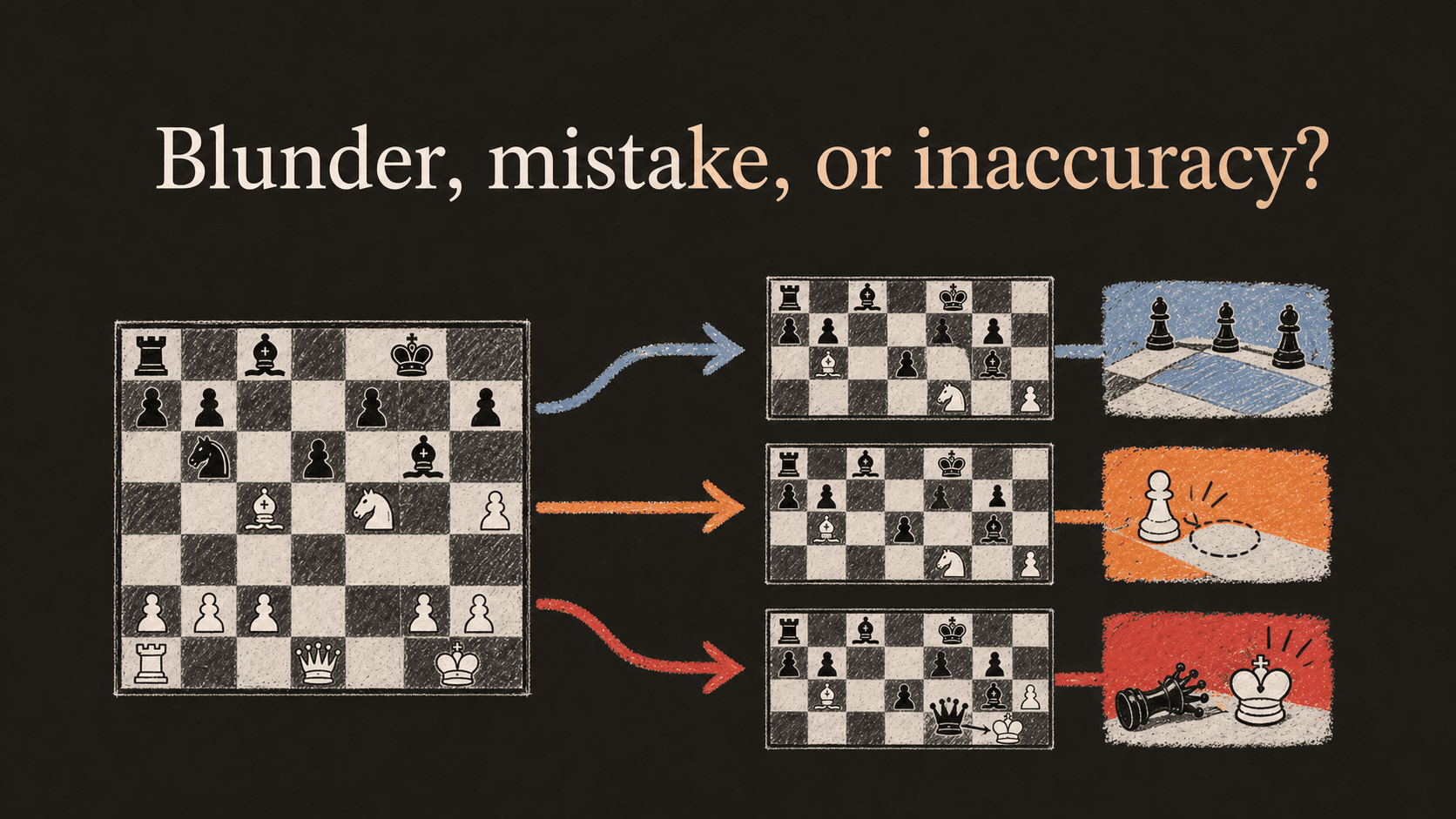
You finish a game, open the review, and the verdict arrives: two blunders, three mistakes, five inaccuracies. But what separates a blunder from a mistake? And which of those ten moves actually deserve your attention?
The three levels, defined
| Symbol | Name | What it means |
|---|---|---|
| ?? | Blunder | Throws away the game or major material. Evaluation swings by roughly two pawns or more, or a forced win becomes a draw or loss. |
| ? | Mistake | Loses meaningful advantage — often around half a pawn to a pawn of evaluation. The game is still playable but clearly worse. |
| ?! | Inaccuracy | A small drift from the best plan. The evaluation slips a fraction of a pawn; the position stays close to equal. |
| ! | Great move | A strong, non-obvious choice — often the only move that keeps the advantage. |
| !! | Brilliant | Best move involving a hard-to-see sacrifice or an only-move save. Rare by design. |
The thresholds vary slightly between platforms — each one tunes its own classification — but the logic is universal: the label measures how much evaluation the move lost compared to the best available move, sometimes adjusted for how winnable the position still is.
Blunders are not always obvious moves
The word "blunder" suggests hanging your queen, and sometimes it is that. But the engine also marks quiet, natural-looking moves as blunders — because they allowed a forcing tactic that neither player saw. That is why the symbol alone teaches you nothing. The number says the move was bad; only the explanation says why: the threat you missed, the defender you overloaded, the file you opened.
This is the gap move explanations exist to fill: turning "?? (-3.2)" into "this left the knight on d4 undefended once the bishop was deflected."
Which mistakes are worth studying
- Study every blunder. These decide games directly, and each one names a pattern you currently cannot see. One understood blunder is a permanent upgrade.
- Study mistakes in games you lost. They usually mark where the game started slipping, before the final blunder.
- Skim inaccuracies, mostly ignore them. Below about 1800 they rarely decide anything. Perfectionism about inaccuracies is procrastination about blunders.
The pattern across games matters most
One blunder is a moment. Ten blunders across ten games are a diagnosis: maybe seven are missed knight forks, or back-rank issues, or pieces left loose after a pawn push. That repeated type — not any single move — is what caps your rating, and finding it is the whole point of asking why you keep losing.
Chessiro's free game review classifies every move, explains each blunder in plain English, and tracks which mistake types repeat across your games — then turns those exact positions into training. Unlimited and free.
Frequently asked questions
What does ?? mean in chess?
Two question marks mark a blunder: a move that throws away the game or a large amount of material. In engine terms, it is a move that swings the evaluation by roughly two pawns or more, or misses a forced win or loss.
What is the difference between a mistake and an inaccuracy?
Both lose value, just different amounts. An inaccuracy (?!) drifts away from the best plan by a fraction of a pawn — the game stays close. A mistake (?) loses meaningful advantage, often half a pawn to a pawn of evaluation, and gives the opponent a real edge.
What counts as a brilliant move in chess analysis?
Platforms mark a move brilliant (!!) when it is the best move and involves a hard-to-see sacrifice or the only path that holds the position. It is a difficulty label, not just a correctness label — brilliant moves are rare by design.
Why does the engine call my normal-looking move a blunder?
Because a tactic existed that you and probably your opponent never saw. The evaluation assumes perfect play from both sides, so a quiet move can be a blunder if it allowed a forcing sequence. This is exactly where plain-English explanations help more than the number.
How many blunders per game is normal?
At beginner level, several per game is completely normal. Around 1000-1200, roughly one big mistake per game decides most losses. Strong club players might blunder once every several games. The trend matters more than the count.

Free game review
Review your games and get actionable insights
Paste a PGN or import your Chess.com and Lichess games, and get a free move-by-move review: every mistake classified, every turning point explained in plain English, with training puzzles built from the exact positions you misplayed.

