How to Improve Your Chess Rating From 1000
By Chessiro
Last updated July 2, 2026
The 1000 plateau is the most common wall in online chess — and the most fixable. Here is the routine that gets players to 1200 and beyond.
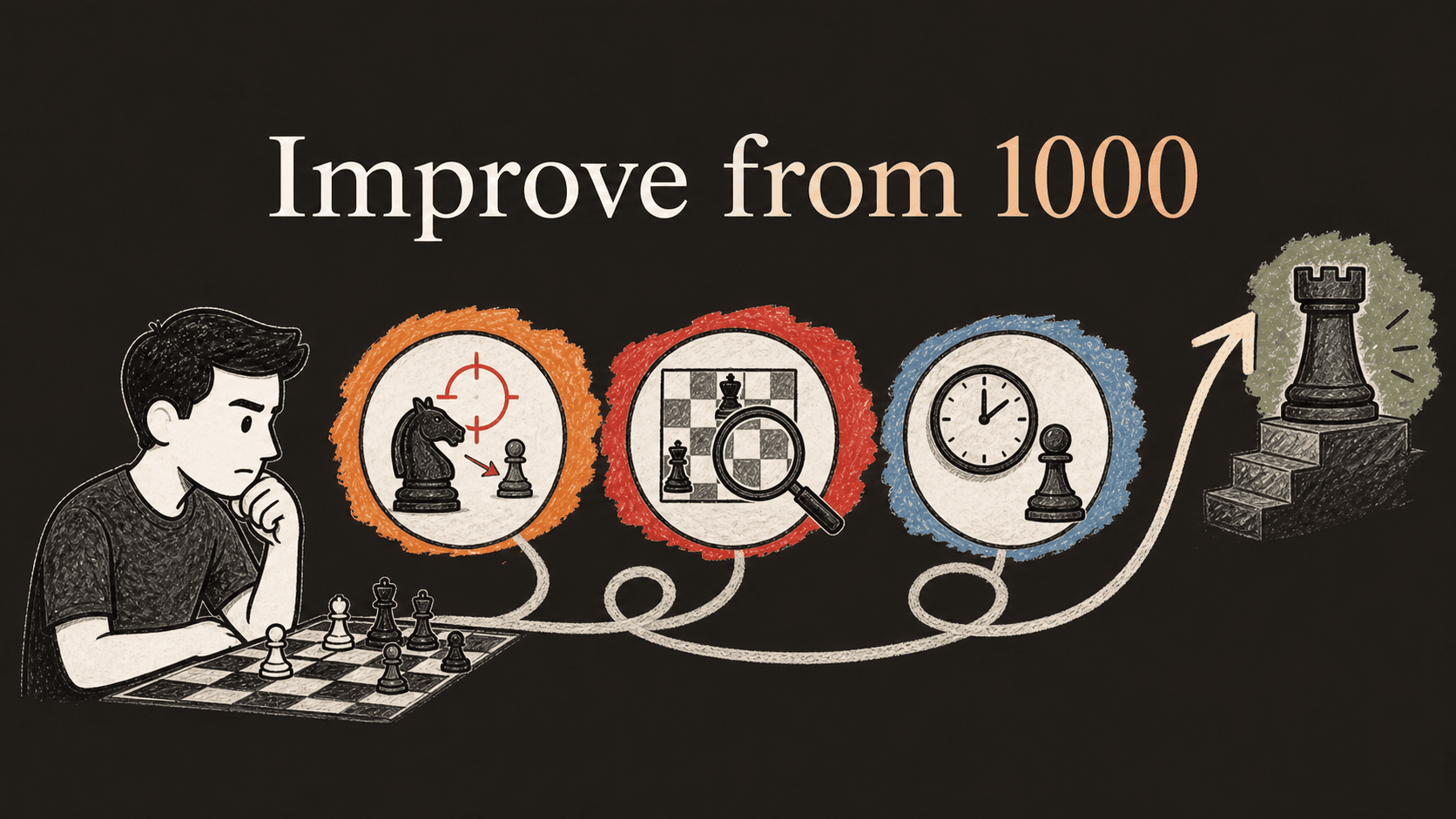
Getting stuck around 1000 is the most common experience in online chess. You are already better than most players, but the rating graph has gone flat and more games are not moving it.
Here is the uncomfortable truth behind that plateau: at 1000, games are not lost because your opponent played well. They are lost because of a small set of recurring mistakes on your side — usually two or three specific ones. Playing more games repeats them. Only finding and fixing them removes them.
Step 1: Blunder-proof your move
One habit is worth more than everything else combined at this level. Before every move, answer two questions:
- What did my opponent's last move attack or threaten?
- After my planned move, is anything of mine undefended or pinned?
This feels slow for the first week. Then it becomes automatic, and an entire category of losses disappears. Most players gain 100 points from this habit alone.
Step 2: Fifteen minutes of tactics, every day
Tactics decide nearly every game under 1500. But volume matters less than rhythm: fifteen focused minutes daily beats a two-hour weekend binge, because pattern recognition is built by spaced repetition. Solve slowly, and when you get one wrong, understand why before moving on — a puzzle you failed and understood is worth ten you guessed.
Step 3: Play slower, play less
Rapid (10 or 15 minutes per side) is the training sweet spot: long enough to practice the blunder-check habit, short enough to play regularly. Two or three focused rapid games a day with review will raise your rating faster than fifteen blitz games without it.
Step 4: Review every loss — this is where the rating is
Every loss at this level contains one moment where the game turned. Your job after each game is to find that moment and name the mistake: a threat you missed, a piece left loose, a trade that helped your opponent. Our game analysis checklist walks through the questions to ask.
If the engine says a move was bad and you cannot see why, run the game through Chessiro's free review. The AI coach explains each mistake in plain English — what the threat was, what the better move solved — and turns your recurring mistakes into training positions. That closes the loop: the mistakes you make become the exercises you practice.
Step 5: One opening per side, understood by ideas
Do not build a repertoire at 1000 — build familiarity. Pick one setup as White, such as the Italian Game or London System, and one defense against each of 1.e4 and 1.d4 as Black. The Caro-Kann is a practical first choice. Learn the ideas, not the lines — our guide to how to learn chess openings shows the method.
The weekly rhythm, in one list
- Daily: 15 minutes of tactics.
- Daily: 1–3 rapid games with the blunder-check habit.
- After every loss: find and name the losing move (free review when unclear).
- Weekly: skim your reviewed games for the repeating mistake — that is next week's focus.
Follow this for two to three months and 1200 is the expected outcome, not the hopeful one. The players who stay stuck are not less talented — they just keep playing instead of reviewing.
Frequently asked questions
How long does it take to go from 1000 to 1200?
With the routine in this plan — daily tactics, longer games, and reviewing every loss — most players cross 1200 within two to four months. Playing hundreds of games without reviewing them can take years, because the same mistakes repeat.
I'm stuck at 800. Does this plan apply?
Yes, with one change of emphasis: at 800 nearly all rating is lost to pieces left undefended. Before tactics or openings, build the habit of checking what your opponent's last move attacks, on every single move. That habit alone is usually worth 200 points.
How do I improve from 1200 to 1500?
The same loop continues, but add simple endgame technique (king and pawn, basic rook endings) and one opening per side that you understand deeply. From 1200 up, review of your own games matters even more because your losses stop having obvious causes.
Should I play bullet to improve?
Not while climbing. Bullet trains pattern speed but reinforces shallow thinking. Rapid games of 10 to 15 minutes give you time to practice the thinking process that ratings actually measure.
Do I need to memorize openings at 1000?
No. You need one reliable setup as White and one against each of 1.e4 and 1.d4 as Black, understood by ideas rather than memorized lines. Games at this level are almost never decided in the opening.

Free game review
Review your games and get actionable insights
Paste a PGN or import your Chess.com and Lichess games, and get a free move-by-move review: every mistake classified, every turning point explained in plain English, with training puzzles built from the exact positions you misplayed.

