How to Learn Chess Openings the Right Way
By Chessiro
Last updated July 2, 2026
Most players study openings backwards: memorize long lines, forget them by move six, blame their memory. The fix is studying ideas first and using your own games as the textbook.
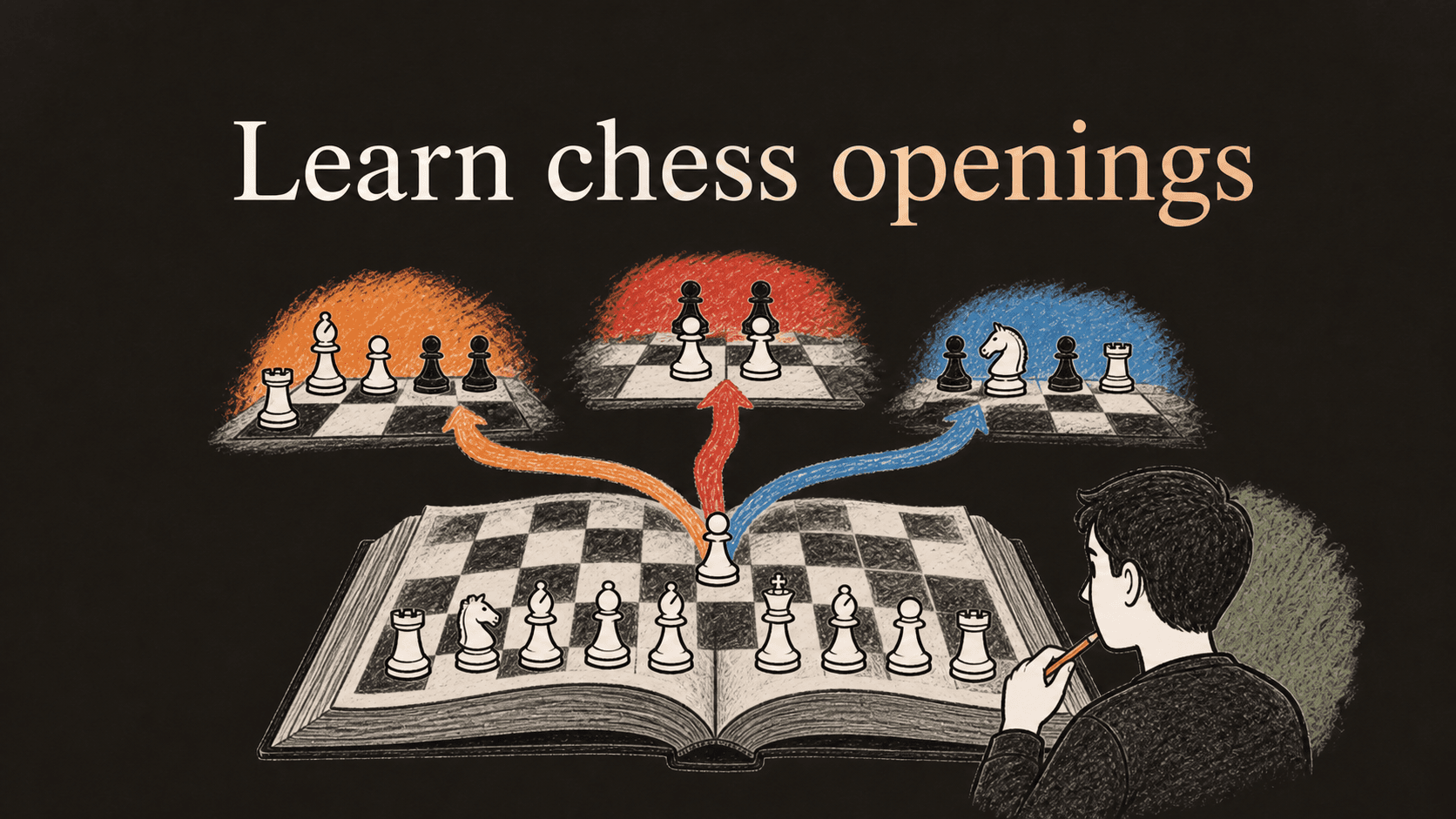
Here is the uncomfortable math of opening study: below 1500, your opponents leave known theory by move five in most games. Every move you memorize beyond that point is preparation for a game that will never happen — while the games you actually play are decided by whether you understand the position you have reached.
So the goal of opening study is not recall. It is arriving at move ten with a safe king, active pieces, and a plan. Here is the method that produces that.
Step 1: Pick three openings, total
One as White, one against 1.e4, one against 1.d4. That covers the opening phase of virtually every game you will play. Choose simple, sound positions whose plans make sense to you, then stick with them long enough to recognize the recurring structures.
Step 2: Learn the why of each move, not the what
Take the first five or six moves of your opening and attach one sentence of purpose to each. In the Caro-Kann: 1...c6 prepares ...d5 with support. In the Italian: 3.Bc4 targets f7, the weakest square in Black's camp. A move with a reason survives an unexpected reply; a memorized move does not.
While you are at it, learn your opening's two or three pawn breaks — the moves like ...c5 in the French or c3-d4 in the Italian that open the position at the right moment. Pawn breaks are the difference between having a plan and shuffling.
Step 3: Play it in every game for a month
No switching after losses. The value of an opening comes from accumulated familiarity with its middlegames, and that only builds through repetition. Twenty games in one opening teaches more than five games in each of four.
Step 4: Let your own games write the study plan
This is the step almost everyone skips, and it is where the actual learning lives. After each game, look at the first twelve moves and ask two questions: where did I leave what I know, and was I better or worse when the opening ended?
When the answer is "worse and I do not know why," run the game through a free review. Chessiro flags the exact move where your opening went wrong and explains it in plain English — the threat you missed, the developing move that was more urgent, the pawn structure you conceded. Fix that one move, and the same position plays itself correctly next time. This loop — play, review, patch — is how a repertoire actually gets built: one real mistake at a time, instead of a hundred hypothetical lines at a time.
Step 5: Expand only when the games demand it
Add a new line when a specific reply keeps beating you — not when a video makes a new opening look exciting. If the Advance Variation keeps crushing your Caro-Kann, study that position and the plans that keep catching you out.
The whole method in four lines
- Three openings: one White, one vs 1.e4, one vs 1.d4.
- Five moves deep, one reason per move, plus the pawn breaks.
- Every game for a month, no switching.
- Review the openings you lost; patch one move at a time.
Frequently asked questions
What is the best way to learn chess openings?
Idea-first, games-second: learn the first five or six moves of one opening and the reason behind each move, play it in every game for a month, then review the games where you left the opening worse or confused. Your own games teach you the move orders you actually face.
How many moves deep should I learn an opening?
Under 1500, five to eight moves plus the ideas is plenty — opponents leave known theory almost immediately. Depth becomes useful around 1600 and up, and even then only in your main lines.
How long does it take to learn a chess opening?
The moves take an evening. Real familiarity — knowing the typical plans, traps, and pawn breaks — takes twenty to thirty of your own games with review. That is why switching openings constantly is the slowest way to learn any of them.
Can I learn chess openings for free?
Yes. Free opening explorers, free databases, and free analysis cover everything a club player needs. Chessiro's opening pages explain every named line in plain English, and its free game review shows where your own opening play goes wrong.
Should I use spaced repetition or Anki for openings?
It works for remembering moves, but it trains recall, not understanding. If you use it, make each card ask why the move is played, not just what the move is. Below 1600, reviewing your own games gives a better return on the same minutes.

Free game review
Review your games and get actionable insights
Paste a PGN or import your Chess.com and Lichess games, and get a free move-by-move review: every mistake classified, every turning point explained in plain English, with training puzzles built from the exact positions you misplayed.