How to Find Your Chess Weaknesses (and Actually Fix Them)
By Chessiro
Last updated July 19, 2026
Ask a room of chess players what their weakness is and most will give you a confident answer. Most of them are guessing. Here is how to find the real answer in your own games — and what to do once you have it.
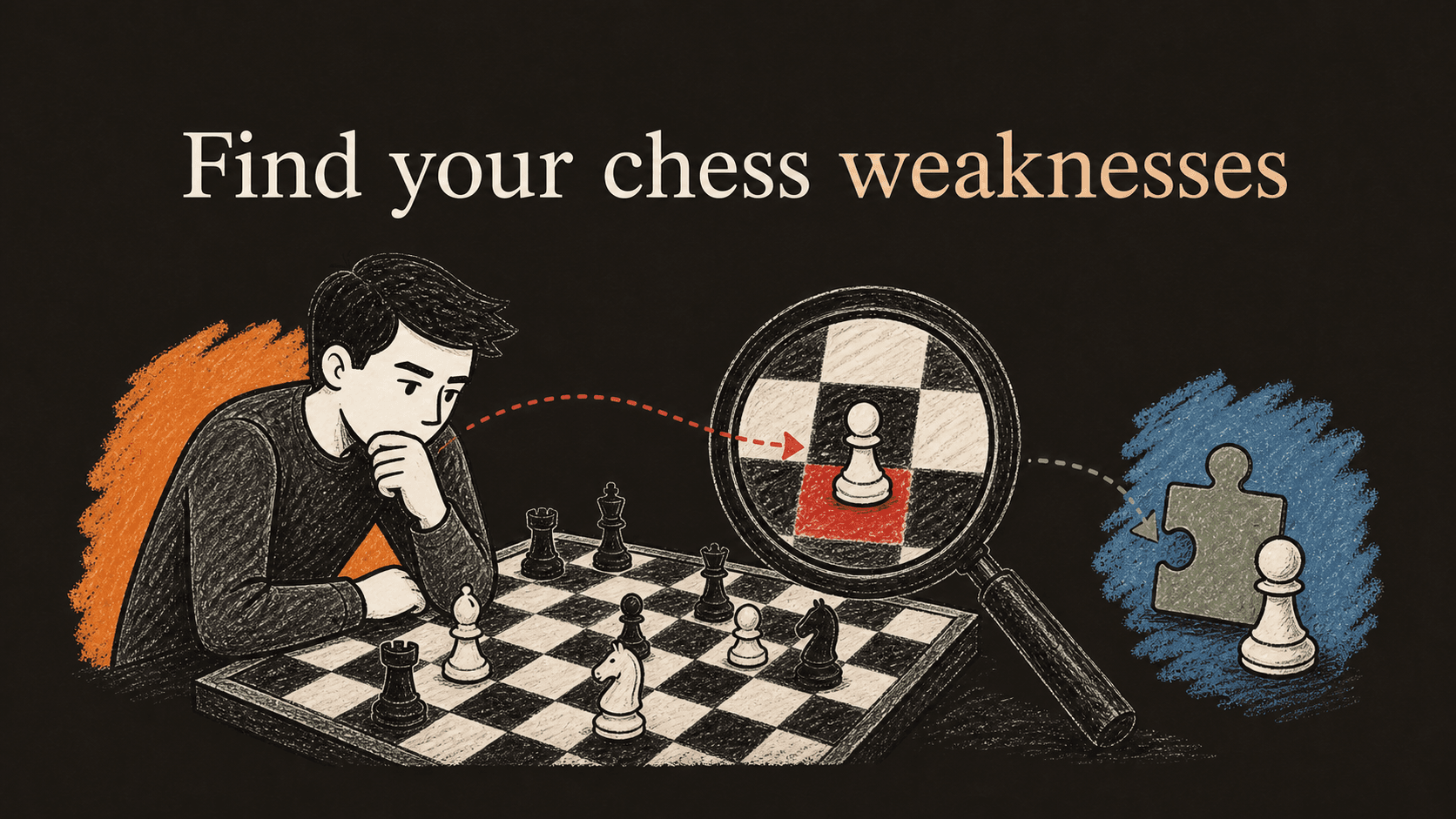
Every improver has a story about their weakness. "My endgames are terrible." "I can't calculate." "I always crack under time pressure." Some of those stories are true. Many are just the last painful loss wearing a costume.
The difference matters, because training against the wrong weakness is worse than no plan at all — it costs you hours and changes nothing. Your actual weaknesses are not a mystery, though. They are written down in your last twenty games. You just have to read them properly.
Why your guess is probably wrong
Memory is a terrible statistician. The blunder from yesterday feels huge; the slow leak of slightly worse positions across fifteen games feels like nothing. Players routinely name the mistake that hurt most recently, not the one that costs the most points over time.
There is also a vanity filter. "I lost a winning endgame" sounds respectable. "I hung my knight to a one-move threat for the fourth time this week" does not — so the second pattern, the fixable one, never gets named.
How to find the real pattern
Set aside one focused hour. You need your last twenty to thirty games and a free analyzer — Chessiro reviews games with no daily limit, and our review checklist walks through the process. Then, for every game:
- Run the review. Let the engine classify the moves so you are working from evidence, not feelings.
- Tag every real mistake with two labels. The phase (opening, middlegame, endgame, time trouble) and the type (hung material, missed opponent threat, no plan, wrong trade, mishandled endgame).
- Count, do not vibe. When you finish, sort the tags by frequency. The top of that list is your weakness — whether or not it matches your story.
One dramatic blunder tells you nothing. The same type of mistake appearing five times in twenty games is a pattern, and patterns are trainable.
The four weaknesses that show up most
After enough reviews, most improving players land in one of these buckets — we see them constantly:
- Loose pieces and one-move tactics. Material left en prise, or a forkable square ignored. The single most common points-bleeder below club level.
- No plan out of the opening. The first ten moves are fine, then the moves stop meaning anything and the position quietly worsens.
- Winning positions that slip away. Good at getting an advantage, poor at the conversion — usually wrong trades or passive endgame play.
- Time trouble decisions. Not a clock problem; a thinking-habit problem that only shows up when the clock removes the safety net.
If your losses feel mysterious rather than explainable, the six real reasons players lose maps closely onto these buckets.
Finding it is half the job — the fix loop
Naming a weakness feels like progress. It is not; it is a diagnosis. The fix is deliberate practice against the exact kind of position that beats you — not generic puzzles, but your positions, the ones where you personally chose wrong.
That is the loop Chessiro is built around: review your games, let the patterns surface in your skill profile, then train them. Smart Shuffle builds puzzle sessions out of the moments you misplayed in your own games, and the AI coach explains in plain English what the stronger move was trying to do. Re-solving your own mistakes over the following days is what actually deletes the pattern — our training plan guide lays out the full loop.
A simple weekly routine
- Once a week: review the week's games and update your tally of mistake types.
- Two or three short sessions: drill positions from your top weakness — fifteen focused minutes beats an unfocused hour.
- Once a month: recount. If the old weakness stopped appearing, promote the next one on the list. That rotation is what improvement actually looks like.
The players who climb are not the ones who study the most chess. They are the ones who keep closing the gap between the mistakes they make and the mistakes they train.
Frequently asked questions
How many games do I need to find my chess weaknesses?
Twenty to thirty recent games is enough for the big patterns to show themselves. Fewer than that and one dramatic blunder can distort the picture. More is better for spotting smaller trends, but do not wait for a perfect dataset — twenty games already tells you more than guessing does.
Can I find my chess weaknesses for free?
Yes. Run your recent games through a free analyzer — Chessiro has no daily review limit — and note every blunder and mistake with two labels: the phase it happened in and the type of error. Sorting by frequency costs nothing but an honest hour.
How long does it take to fix a chess weakness?
A specific, well-defined weakness — like hanging a particular piece to forks — can shrink noticeably within a few weeks of targeted practice. Vague goals like getting better at calculation take far longer because you cannot tell whether you are improving. The narrower the weakness, the faster the fix.
Do I need a coach to find my weaknesses?
A coach speeds things up, but the raw material — your games and an engine — is available to everyone. A good coach mostly does what this article describes: reviews many of your games, names the recurring pattern, and assigns practice against it. You can run a solid version of that loop yourself.
What if I have several weaknesses at once?
You do — everyone does. Fix the most frequent one first, not the most embarrassing one. A weakness that costs you a piece every third game matters more than a subtle endgame habit that costs you half a point occasionally. Frequency times cost is the priority order.

Free game review
Review your games and get actionable insights
Paste a PGN or import your Chess.com and Lichess games, and get a free move-by-move review: every mistake classified, every turning point explained in plain English, with training puzzles built from the exact positions you misplayed.

