Chess Puzzles From Your Own Games: Why They Work Better
By Chessiro
Last updated July 19, 2026
Your puzzle rating is 400 points higher than your game rating, and the gap never closes. Here is why random puzzles struggle to transfer — and why the positions from your own losses are the best training material you own.
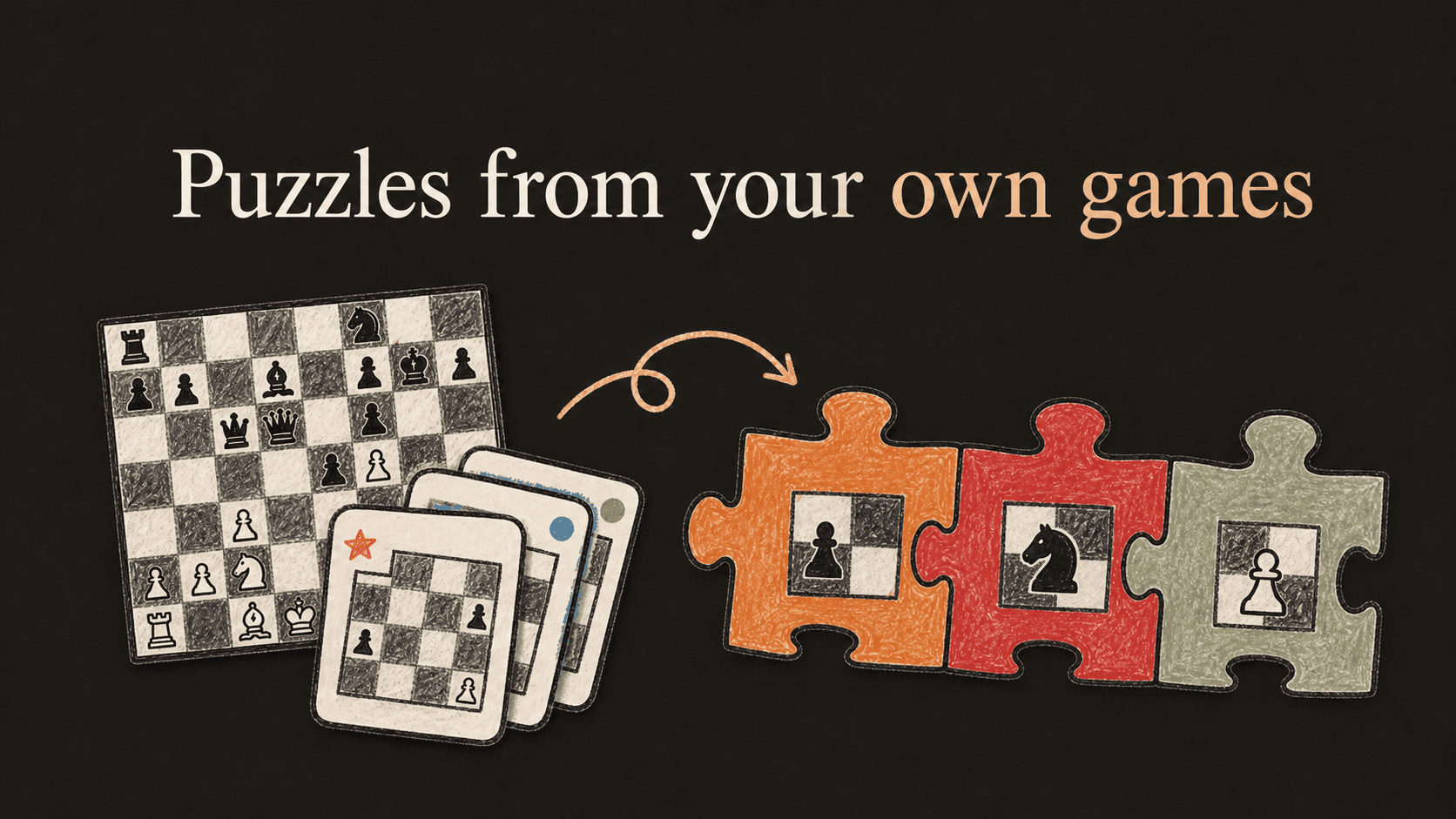
Ask around and you will find the same odd gap everywhere: players with a 2200 puzzle rating and a 1400 game rating. They are not lazy — they solve puzzles daily. The tactics just refuse to show up in their games. That gap has a name: the transfer problem. And it explains why the most effective puzzles you can solve are hiding in games you already played.
The transfer problem with random puzzles
A puzzle app hands you a position with a silent promise: there is a win here, find it. That cue does half the thinking for you. In your own games nobody taps your shoulder — the skill that decides games is noticing that a tactical moment exists at all, which is precisely the skill puzzle rush never tests.
There is a second mismatch. Random puzzle sets are sampled from millions of other people's games. The themes that decide your games — the structures from your openings, the mistakes your rating band actually makes — appear at whatever rate chance gives you. You end up sharp at patterns you rarely reach and soft on the ones that beat you every week.
Why your own games are better puzzle sources
Three reasons, and they compound:
- You lived the position. You remember the game, the plan you had, the moment it went wrong. That emotional hook makes the corrected idea stick in a way an anonymous position never does.
- The frequency is honest. Your puzzle set is drawn from your actual mistakes, so training time lands exactly where your points are leaking.
- The context repeats. The positions come from openings and structures you play every week — so the pattern you fix tonight has a real chance of appearing in tomorrow's game.
The science-y part, kept honest
Two well-established learning principles do the heavy lifting here. Retrieval practice — being forced to produce an answer rather than re-read it — is one of the most reliable ways to make knowledge durable. And spaced repetition — reviewing at expanding intervals just as you start to forget — beats cramming the same total time into one sitting.
The woodpecker method applies both to chess: solve a fixed set of puzzles repeatedly, in faster and faster cycles, until the patterns become reflexes rather than calculations. It works with any puzzle set. It works noticeably better when the fixed set is the list of mistakes you personally keep making.
The manual version (free, slightly tedious)
- Review each game you play — our analysis checklist keeps it quick.
- Save every position where the evaluation swung against you: a screenshot, a FEN in a notes file, anything you will actually revisit.
- Re-solve each saved position the same day, again after two or three days, then once more a week later — without looking at the engine line first.
- Retire positions you now solve instantly. Keep the ones that still trick you.
This works. It also dies the moment life gets busy, which is why most players who try it quit within a month.
The automated version
This is the loop we built Chessiro to close. After your games are reviewed, Smart Shuffle collects the moments you misplayed and deals them back to you as training puzzles — shuffled, so you cannot lean on remembering the answer, and weighted toward the patterns you keep repeating. The AI coach fills in the "why" in plain English when a position still does not make sense (more on that in why move explanations matter).
However you build the set, the protocol is the same: short sessions, your own positions, spaced repetition, and honesty about which ones still beat you. Fifteen minutes a day of that will do more for your results than an hour of puzzle rush — our training plan guide shows how to fit it into a week.
Frequently asked questions
Are random chess puzzles useless?
No. Random puzzles build a broad vocabulary of tactical patterns, which is especially valuable for newer players. The problem is relying on them alone: the patterns are drawn from other people's games, so the ones you personally miss never get extra attention. Add puzzles from your own games and the two reinforce each other.
How often should I repeat a puzzle from my own game?
A simple spacing works well: solve it the day you review the game, then again after a few days, then once more a week or two later. The goal is to recall the idea when it is no longer fresh. Once you solve a position quickly and confidently twice in a row, retire it.
What is the woodpecker method in chess?
The woodpecker method is solving the same fixed set of tactical puzzles over and over, in faster cycles each time, until the patterns become reflexes. It applies perfectly to mistakes from your own games: a small personal set, repeated on a schedule, beats an endless stream of positions you never see again.
What rating level benefits from puzzles based on their own games?
Roughly everyone below master level, and honestly many masters too. The approach is most dramatic for players in the 800 to 1800 range, where games are decided by repeated, identifiable mistakes — exactly the kind a personal puzzle set targets.
Can I build puzzles from my own games for free?
Yes. Manually: review a game in any free analyzer, save the positions where you went wrong, and revisit them on a schedule. Automatically: Chessiro's Smart Shuffle turns the mistakes from your reviewed games into training sessions for you, with a free weekly allowance.

Free game review
Review your games and get actionable insights
Paste a PGN or import your Chess.com and Lichess games, and get a free move-by-move review: every mistake classified, every turning point explained in plain English, with training puzzles built from the exact positions you misplayed.

