Is 1500 a Good Chess Rating?
By Chessiro
Last updated July 2, 2026
Short answer: yes. 1500 is well above the typical online player. Here is what the number means on each site and why the next 300 points are the hardest ones yet.
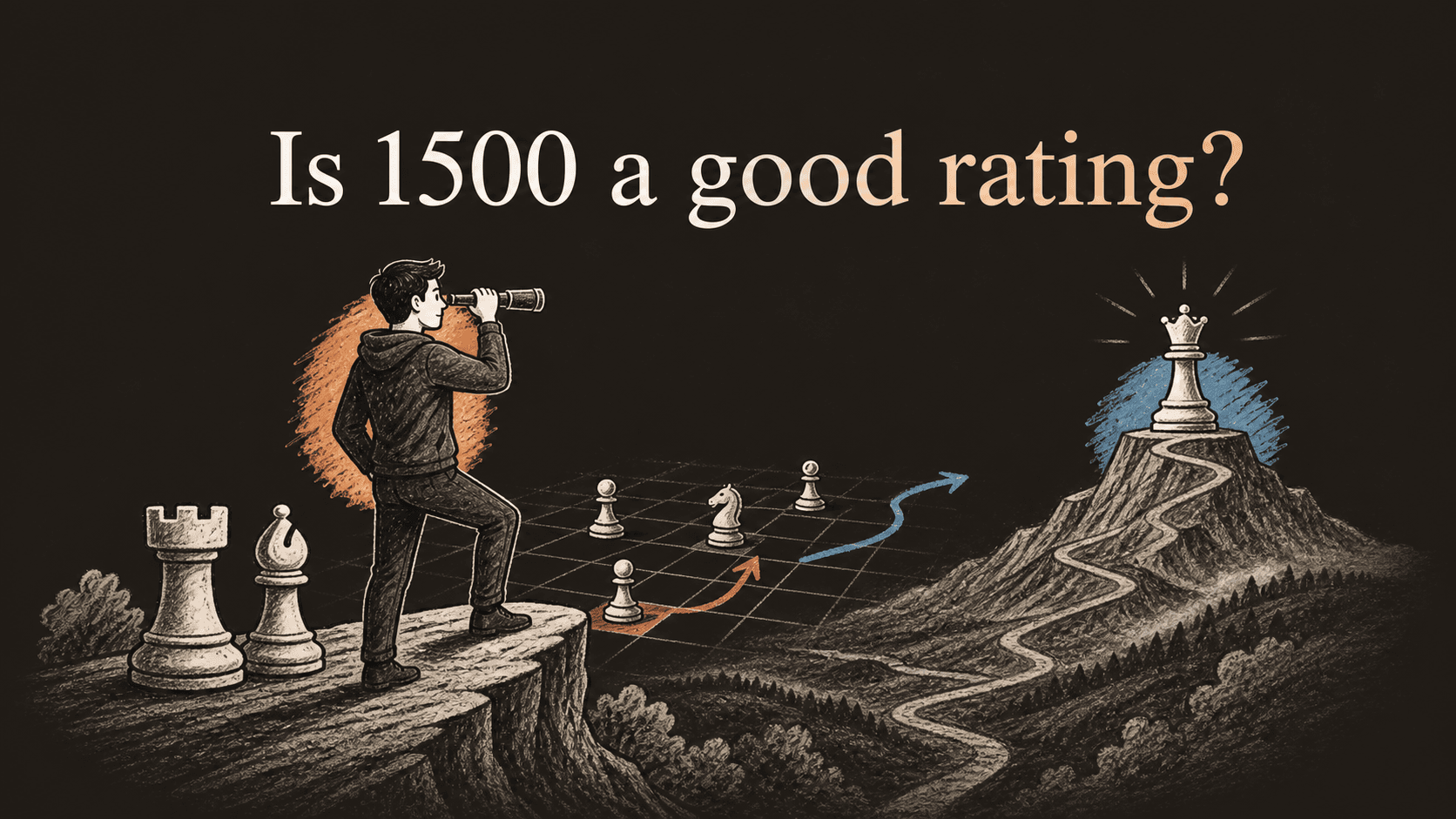
Yes — 1500 Elo is a genuinely good chess rating. On Chess.com, a 1500 rapid rating puts you well above the typical active player. You would beat most casual opponents, hold your own at a chess club, and most people who ask this question underestimate how strong 1500 actually is.
What 1500 means across platforms
- Chess.com rapid: well above the typical active player, and your stats page shows your exact percentile. Casual players almost never reach this without deliberate study.
- Lichess: 1500 Chess.com rapid is about 1800 in Lichess rapid, and 1500 Chess.com blitz is about 1750 in Lichess blitz, according to the ChessGoals rating survey (July 2026 update). Lichess starts everyone at 1500 and runs higher across the board.
- Over the board: in the same survey, 1500 Chess.com rapid lines up with roughly 1700 FIDE. Treat that as a rough guide: only players who have both ratings are counted, and conversions vary a lot from player to player.
To convert your own rating, use the Lichess to Chess.com rating converter. For the full background on why these numbers differ, see chess ratings explained.
The 1500 plateau is different from the 1000 plateau
At 1000, games are lost to one-move blunders, and progress means making fewer of them. At 1500 your opponents rarely hand you the game. Wins have to be constructed, and the skills that got you here stop being enough:
- Calculation depth. Two-move tactics are not enough; you need to see the resource your opponent has at the end of the line.
- Positional understanding. Pawn structure, piece activity, and weak squares start deciding games where no tactic exists.
- Endgame technique. Equal endgames stop being automatic draws. The player who knows rook endings wins them.
- Opening depth. Not more openings — deeper understanding of the ones you already play, including typical middlegame plans.
How 1500s become 1800s
Players who break through share one habit: they study their own games more than they study general content. Your games are a map of exactly which of the four skills above is costing you points. Generic courses are not.
A practical loop: after every serious game, run it through a free PGN analysis, read the explanation for each mistake, and tag it — tactic missed, plan wrong, endgame misplayed. After twenty games the pattern is unmistakable, and that pattern is your study plan. Chessiro automates exactly this: it finds the turning points, explains them in plain English, and builds training positions from your own mistakes.