Analyze Your Chess Games for Free.
By Chessiro
Last updated March 2, 2026
A simple way to understand your games, track mistakes, and turn analysis into practice.
Every chess improvement guide, every coach, every GM who's ever given advice will tell you the same thing: analyze your games. It's one of the highest-leverage activities for getting better at chess because it starts from the positions you actually played.
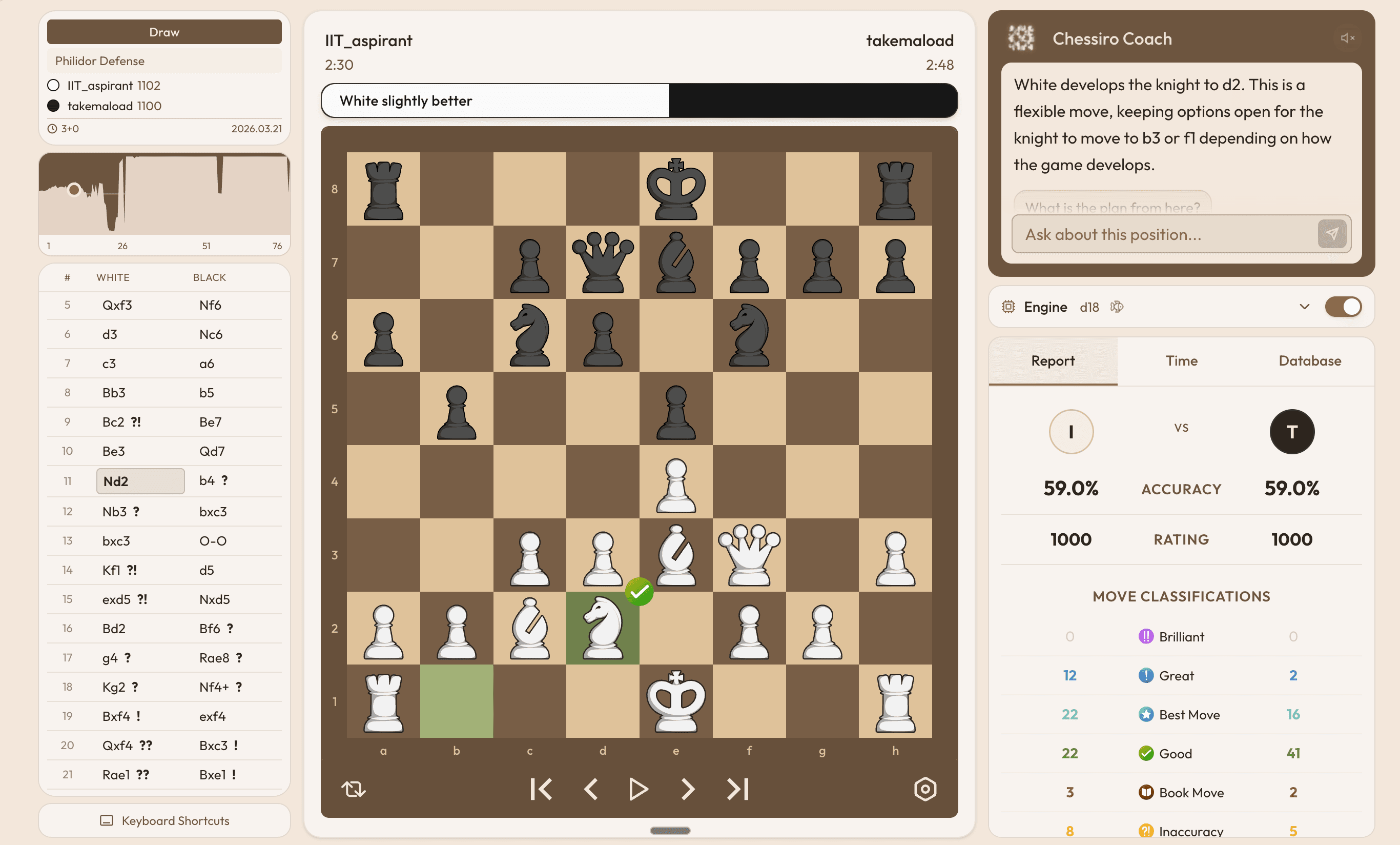
Chessiro is built around that loop: import a game, analyze every move, understand the critical moments, and practice the positions where you can improve.
What Chessiro gives you
Chessiro focuses on making post-game learning fast and readable. Every imported game can get Stockfish 19 analysis with:
- Move classifications, see which moves changed the direction of the game
- Accuracy percentage, get a quick read on how cleanly each side played
- Evaluation graph, visualize how the advantage shifted throughout the game
- Opening detection, understand where the game left known theory
- Replay Mistakes, practice selected positions from your own games
The goal is not just to show engine numbers. The goal is to turn the game you just played into a short study session you can actually finish.
Why AI coaching helps
Engine output is powerful, but it can be hard to translate into a plan. If the engine prefers a quiet knight move by half a pawn, that number alone may not tell you what changed in the position.
Chessiro Coach is designed to explain the idea in normal chess language: what threat mattered, what plan was missed, what a stronger move was trying to achieve, and how to think about similar positions next time.
Our take: analysis should lead to practice
The most useful analysis is the analysis that changes what you do in the next game. That is why Chessiro connects game analysis with targeted practice.
After a game is analyzed, Replay Mistakes can turn selected moments into puzzles. Instead of only reading that a move was inaccurate, you get another chance to find the stronger idea yourself.
That repeat loop, play, analyze, understand, retry, is what we are building around.
So what's not free?
We're not running a charity, we need to sustain the product. Here's how we think about it:
- Free: Game analysis with Stockfish, move classifications, accuracy scores, eval graphs, opening detection. No daily limit. This covers the core analysis every chess player needs.
- Free (limited): AI Coach explanations (2 sessions/week) and Replay Mistakes puzzles (10/week). You get to experience the advanced features, just not unlimited.
- Pro: Unlimited AI coaching, unlimited Replay Mistakes, and everything else without limits. This is what funds Chessiro.
The idea is simple: the core analysis that every chess player needs to improve should be easy to access. The advanced AI features that require significant compute are where the paid tier comes in.
How to get started with free game analysis
It takes about 30 seconds:
- Go to chessiro.com and sign in with Google or email
- Connect a supported chess account or upload a PGN
- Your recent games are automatically imported
- Click any game to run Stockfish 19 analysis
- See move-by-move analysis with classifications and accuracy
You can also upload any PGN file directly, useful if you play on other platforms or want to analyze over-the-board tournament games.
For the fastest path, start with free chess analysis on Chessiro and paste your PGN.
No credit card is needed to start. Just bring a game and analyze it.
Why this matters for chess improvement
Analyzing your games is how you connect chess advice to your actual decisions. You see the positions you misunderstood, the tactics you missed, and the plans that kept appearing in your games.
The more consistently you do that, the easier it becomes to spot recurring mistakes and build better habits.
That is the job of Chessiro: help you turn your own games into practical training.

Free game review
Review your games and get actionable insights
Paste a PGN or import your Chess.com and Lichess games, and get a free move-by-move review: every mistake classified, every turning point explained in plain English, with training puzzles built from the exact positions you misplayed.

