Can an AI Chess Coach Actually Help You Improve?
By Chessiro
Last updated March 15, 2026
We build an AI chess coach, so we're biased. But here's an honest answer anyway.
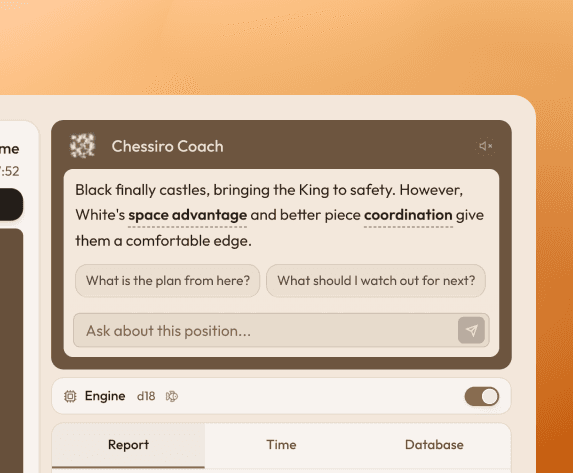
Short answer: yes, for most players. But it's not perfect, and we're not going to pretend it is.
Let's be real about accuracy
Our AI chess coach gets it right about 75-80% of the time. The other 20% it can be off, sometimes it misses a nuance, sometimes it oversimplifies a complex position, sometimes it explains something in a way that's not quite right. We're upfront about this because we think honesty matters more than marketing.
But here's the thing: even at 75-80% accuracy, an AI coach is still way more useful than staring at an engine eval bar trying to figure out why your move was bad. The AI translates engine numbers into ideas you can actually understand. “You lost the game because your knight had no good squares after you pushed your pawns too far”, that's something you can learn from. “-1.3” is not.
Think of it this way: if a friend who's 200 rating points above you reviews your game, they might occasionally get something wrong too. But their explanations are still infinitely more useful than no explanation at all. That's what AI coaching is, a friend who's always available and usually right.
The real question: does hiring a chess coach make sense for you?
A good chess coach costs $30-80/hour. Some titled players and GMs charge even more. If you're a 1000-rated player or a beginner, does it make sense to pay a Grandmaster to tell you that you're hanging pieces and missing basic forks? Probably not.
At that level, what you need is simple: someone (or something) to explain what went wrong in your games, in language you understand, after every game. Not once a week for an hour. After every game. That's what AI coaching does. It's there at 2am on a Tuesday when you just lost a frustrating blitz game and want to know what happened.
For most club players, the mistakes you're making are patterns. You keep missing the same types of tactics, you keep putting your pieces on the wrong squares in the same openings, you keep getting into time trouble in the same types of positions. An AI coach catches these patterns and explains them clearly. You don't need a GM for that.
What AI chess coaching is good at
Explaining tactical mistakes. When you miss a fork, a pin, or a discovered attack, the AI can explain what you missed, why the tactic works, and what pattern you should have noticed. This is where AI coaching genuinely shines, tactical explanations are concrete and verifiable, which plays to AI's strengths.
Translating engine speak into human ideas. Engines think in numbers. Humans think in concepts. AI is genuinely good at bridging the gap. “Your knight on d5 is strong because it can't be challenged by any pawn and it puts pressure on the weak f6 square”, this is the kind of explanation that helps you learn, and AI is well-suited for generating it.
Consistency and availability. A human coach reviews your game once a week. An AI chess coach reviews every game, every time, and never gets tired. If you're making the same mistake in 30% of your games, an AI catches that pattern more reliably than a coach who sees you for one hour a week. And it's available after every single game, no scheduling, no waiting.
Cost. This is the biggest practical factor. Most players can't afford $50/hour for regular coaching sessions. AI coaching costs a fraction of that, and the free tier alone gives you more useful feedback than engine analysis with no explanation.
Where AI coaching falls short
We should be honest about the limitations.
Deep strategic understanding. If you're above 2200 and preparing for tournaments, you probably need a human coach for opening preparation and deep strategic work. AI can explain what the engine recommends, but it doesn't “understand” long-term strategic plans the way a strong human player does. A GM coach might tell you that your pawn structure is creating weaknesses that won't matter for 15 moves, an AI typically focuses on the immediate position.
Personalized learning style. AI coaching is one-size-fits-all in how it explains things. A human coach adapts to how you think, they notice you learn better with visual examples, or that you struggle with certain types of positions. AI is getting better at this, but it's not there yet.
Motivation and accountability. Having a real person who knows your goals, checks your progress, and pushes you to study, there's no AI replacement for that. If what's holding you back is discipline rather than knowledge, a human coach is better.
The 20% error rate. Yes, that 20% where the AI gets it wrong can be annoying. Sometimes it'll explain a position in a way that's slightly off, or miss a key detail. You learn to cross-reference with the engine eval when something feels wrong. It's a tool, not a replacement for your own critical thinking.
Who benefits most from AI chess coaching?
- Beginners (600-1200): You're losing material to basic tactics constantly. AI coaching is perfect, it explains what you missed in every game in simple terms, and you'll see rapid improvement just by reviewing your games regularly.
- Intermediate (1200-1600): The sweet spot. You understand the basics but keep making the same types of mistakes. AI coaching identifies your patterns, explains concepts you're missing, and gives you targeted practice through Replay Mistakes puzzles.
- Advanced intermediate (1600-2200): Still very useful. The AI explanations might feel obvious for simpler positions, but it catches things you miss in complex middlegame positions. At this level, the consistency of reviewing every game is what drives improvement.
- Strong players (2200+): AI coaching becomes supplementary. You probably need a human coach for specific weaknesses and tournament preparation. But AI review is still useful for catching tactical oversights and maintaining your review habit.
AI coaching vs human coaching: do you have to choose?
The best setup, if you can afford it, is both. Use a human coach for structured lessons, opening preparation, and long-term guidance. Use AI coaching for reviewing every game between lessons, so you come to your coach sessions having already identified your patterns and questions.
But if you can only pick one, and for most players, it's a budget question, AI coaching gives you 80% of the benefit of game analysis at a fraction of the cost. The most important thing is that your games actually get analyzed. Analysis that happens is infinitely better than perfect analysis that doesn't.
The bottom line
If you're a beginner or an intermediate chess player, AI coaching is the most practical way to understand your games and improve. It's available after every game, it costs a fraction of a human coach, and it explains things in a way that actually helps you learn, even if it's not right 100% of the time.
The alternative for most people is not “hire a GM coach”, it's “don't review your games at all.” And that's way worse than a coach that's right 80% of the time.
We're building Chessiro to be the best version of this. It's not a GM in your pocket, it's a tool that makes game analysis more useful, more consistent, and more likely to actually happen. And for most players, that's what matters.

Free game review
Review your games and get actionable insights
Paste a PGN or import your Chess.com and Lichess games, and get a free move-by-move review: every mistake classified, every turning point explained in plain English, with training puzzles built from the exact positions you misplayed.

